
Not feeling particularly keen to write about any of the “B” books I’d already read, I decided to pick up a book that’s been on my to-read list for most of my life: Beat to Quarters by C.S. Forester. The “Hornblower Saga” is a favorite in my family – my grandfather, parents, and siblings are all fans, so I’ve been hearing about it all my life. I’m not sure why I never picked it up before, but the timing felt right to start now – I’m in the mood for naval adventure, I needed a novel starting with “B” for this series, and, perhaps most of all, it seemed fitting to read one of my grandfather’s favorite novels now, one year after his passing.
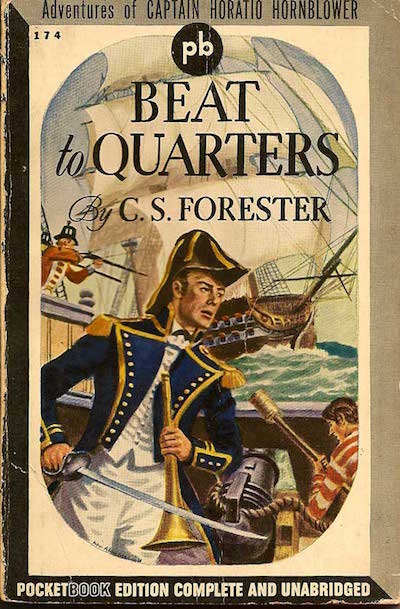

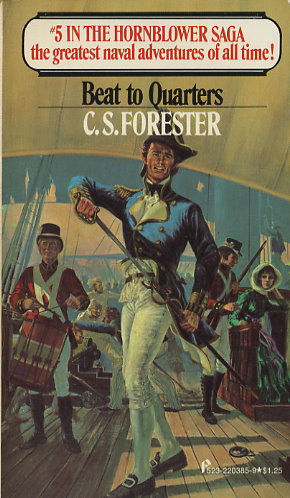
Beat to Quarters (a.k.a. The Happy Return) is the fifth book in the series, chronologically, though the first written by Forester in 1937. We’re introduced to Captain Horatio Hornblower as he anxiously awaits a land-sighting after seven long months at sea with no sight of land and rapidly diminishing supplies. He’s on secret orders from the crown to arrive at the Gulf of Fonseca without detection by the Spanish fleet (or anyone else, who might leak word of his ship, the Lydia‘s, presence), aid a group of Spanish rebels, capture or destroy a hostile ship that out-guns his own frigate two-to-one, and open a new trade route. Under these orders of secrecy, and distrusting his own natural openness, Hornblower hasn’t even shared his destination or his mission with his closest officers. Mutiny is a concern and failure in any part of his mission will mean certain personal and professional disgrace – if he lives to return to England.
Forester sketches out the situation quickly, but it was the insight into Hornblower himself that had me hooked from the first chapter. Although he’s quick-witted and capable and could easily be written as a superhuman hero, Hornblower’s awareness of his own shortcomings keeps him grounded and human. For the sake of ship discipline (and the success of his mission), he maintains a distance from his crew and affects an imperturbable mask to hide his doubts and concerns. His very deliberate efforts toward a stoic facade could be construed as simple vanity or as an unappealing and out-of-date ideal of masculinity. Certainly no one is as critical of Hornblower as Hornblower himself.
But with our insight into the workings of Hornblower’s mind and situation, we find that this attitude is very necessary for the survival of himself and his crew. By keeping his worries to himself and affecting an unflappable demeanor, Hornblower instills confidence – and even a measure of awe – in his officers and crew. It is a delicate balance he must strike to maintain discipline and loyalty, lest his men grow uneasy about their precarious situation and lose faith in him to see them through safely. And he is very aware of how his every move influences their opinion of him.
“The strict cold captain, the stern disciplinarian, had for a moment revealed human characteristics and had admitted his inferiors to fellowship. Any one of the three junior officers would at that moment have laid down his life for his captain – and Hornblower, looking round at their flushed faces, was aware of it. It gratified him at the same moment it irritated him; but with a battle in the immediate future which might well be an affair of the utmost desperation he knew that he must have behind him a crew not merely loyal but enthusiastic.” – Beat to Quarters
The downside to this strict discipline and image management, of course, is that Hornblower is himself a very lonely character. The state of the mission, the health and discipline of his crew, and the personal repercussions if he fails in any respect keeps him a state of near-constant anxiety, with no one in whom he can confide. Taken in this light, his posturing for allies and enemies alike, his stern attitude toward the men under his command, and his own exacting self-discipline become more sympathetic traits than if he were simply a man who delights in lording over his inferiors. Rather, he is a man under great strain, attempting to keep his crew, his mission, and his own person from falling apart.
I’m so glad I finally sat down to read this book, and I enjoyed talking to my family as I read, now that I could finally join in the Hornblower discussion. As I mentioned, this series has always loomed large in my family’s book talk, and I grew up considering it one of the great classics, possibly part of the Western canon, for all the weight it received from my folks. So you can imagine my surprise when I grew up and realized that no, it’s not a particularly popular or even well-known series – if internet chatter and the utter lack of presence in my (large) city’s public library are any indication! And after reading it – okay, I can see why it doesn’t have the greatest staying power. For one thing, genre fiction generally moves in and out of the public consciousness pretty quickly, and for another, there are definitely parts that have not aged well (re: race and gender). But I seem destined to champion forgotten writers of the early twentieth-century, so I’m here to tell you, Beat to Quarters is a ripping yarn, and if you like a good sea-faring adventure, you should give this one a try. I’m already looking forward to consuming the rest of the saga.
-b

 Book It With Becca
2 thoughts on “Reading the Alphabet: B is for Beat to Quarters”