

If you know me at all, you know that Rafael Sabatini’s Scaramouche: A Romance of the French Revolution is among my very favorite books. I reread it often and think of it constantly, and I’m always eager to persuade others to give it a chance because so few have even heard of it, let alone read it. Which is a CRIME. And well, if Scaramouche has a small audience, its sequel, Scaramouche: The King-Maker barely has a theater. But I finally got my hands on a copy this year, and while it’s hard to say I love it as much as the original, I do love it quite a bit. So sit back, and let me tell you all about it.
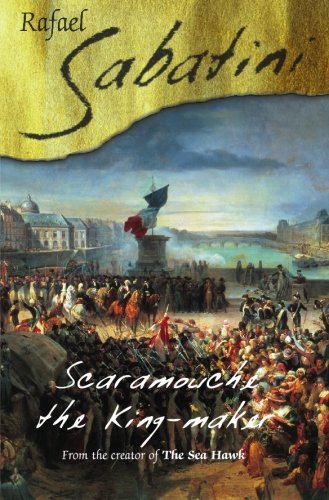
Book two picks up right where book one left off, with our protagonist, André-Louis Moreau turning his back on the revolutionary cause he championed for so many years and escorting his god-father and fiancée, Aline, out of France. They find themselves among fellow émigrés in the court of the French Regent, where André, a known political figure, is less welcome than his aristocratic friends. As the conflict grows into the Reign of Terror and as Aline is drawn further into court intrigues, André agrees to join a dangerous mission to infiltrate and topple the revolution.
This sequel was both what I expected it to be and not what I expected it to be. Some reviews I’ve read (and the narrator himself) accuse the André of this book of being bitter and more ruthless version than we saw in book one. I’m not sure I agree – at least with that second part. In my mind, André-Louis has always served his own purposes, often regardless of the effect on others, unless he bears them particular affection. Ever Scaramouche, if you will.
It is true, however, that in The King-Maker, André is at last honest about his selfish motives. After sacrificing his political career and growing disillusioned with the course of the revolution he once championed, he now serves the French Regent with the sole aim of marrying Aline after the conflict’s end. He isn’t spurred by any idealistic convictions now, and – never having truly believed he that was before – I find this honesty about his motivation an interesting turn, as it signals André’s disillusionment, as well as a greater self-knowledge. And, of course, I’ve always enjoyed André in the role of intriguer, so watching him scheme and manipulate entertained me immensely!
Strange as it may seems, I actually found this André softer and more sympathetic in many ways. Where the Scaramouche took place over many years, The King-maker is concerned with the events of a shorter period — no more than two years, I believe, without going back to check dates. Zoomed in on a shorter (and particularly intense) time period, we’re free to linger and examine his emotions more closely. If I was amused by André’s callous theatricality in the first book, I was at last in true sympathy here, in his hours of fervent hope and crushing despair.
Whether he’s laughing at the follies of humanity or studying its more sordid aspects, Sabatini can spin a yarn like few others, and I was utterly enthralled throughout. Adding a new intensity to the elements I already loved in the first novel (as well as some new favorite characters), The King-Maker is an instant favorite that I look forward to revisiting often in coming years.
–b

 Book It With Becca
One thought on “Scaramouche: The King-Maker by Rafael Sabatini”