
Howards End is an excellent novel that is surprisingly difficult to write about, not because there’s nothing to say but because there is so much. It’s hard to know where to focus – or even how to summarize without getting out into the weeds of exposition and philosophy and writing mechanics. So instead of worrying you (or myself) too much with all of that, I’m going to reign myself in and consider the novel’s central idea: Howards End itself. Because, somehow, the house is more of an idea, or an ideal even, than just a location. Despite the limited time actually spent there in-story, it is a standard and an influence and the true heart of the novel.
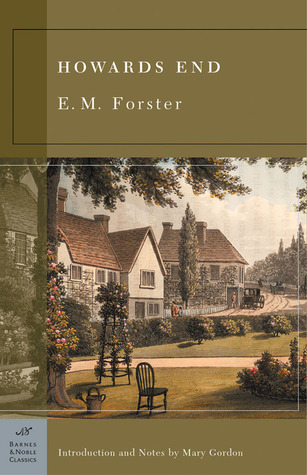
The book is concerned with the entanglements and clashes of three families: the free-spirited and intellectual Schlegels, the wealthy and conventional Wilcoxes, and the poor (and rather disreputable) Basts. Through love affairs, deaths, and many coincidences, these very different families are drawn together and torn apart, exposing their foibles and hypocrisies along the way. At the center of it all is the beloved country home of the late Mrs. Wilcox, Howards End, which she desires to be bequeathed to her young friend, Margaret Schlegel – a final act of independence that outrages her overbearing family.
In a clever and inspired move, Forster uses location to illustrate character. By observing how members of the families feel about Howards End, readers can intuit how we are to feel about them: those who find worth in it and react to the “soul” of the house are sympathetic and free, and those who see it merely as a possession are unfeeling and confined. Although there are certainly many stories concerned with place and how places are valued by different people, I can’t think of another that does it on such an intimate scale (this is, after all, only a small country home and not a city or village) and with such subtlety. But, of course, Forster is a master at the use of place.
Forster’s writing has a very dry tone, which can make his novels a little difficult to get into at first, as you’re trying to figure out the characters and how they fit together. But, as usual, I was drawn into this simple world of complicated relationships, and I found myself laughing aloud many times at his wry humor and deft revelations of the characters. (Can anything top Mr. Wilcox’s hilariously dramatic “confession”?) After enjoying A Passage to India and A Room With a View (one of my all-time favorites), Forster’s deft work in Howards End confirms him as one of my favorite authors. I don’t see myself rereading it as often as A Room With a View, but it’s certainly a story I’ll revisit eventually. In the meantime, its characters and ideas give me plenty of food for thought.
–b

 Book It With Becca