
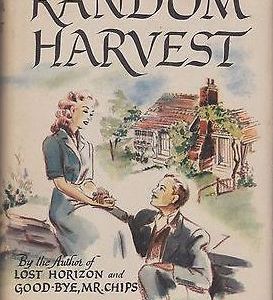
We all know the movie is never as good as the book… but what if it is? Random Harvest (1942) is one of those rare adaptations that understands its source material (James Hilton’s 1941 novel of the same name), as well as the fundamental differences between the two mediums of film and novel. And on a subjective note, they both possess a certain magical quality, drawing me into a past that fascinates, just as our hero is drawn to the secrets of his lost memories. Let’s dive into the book first, shall we?
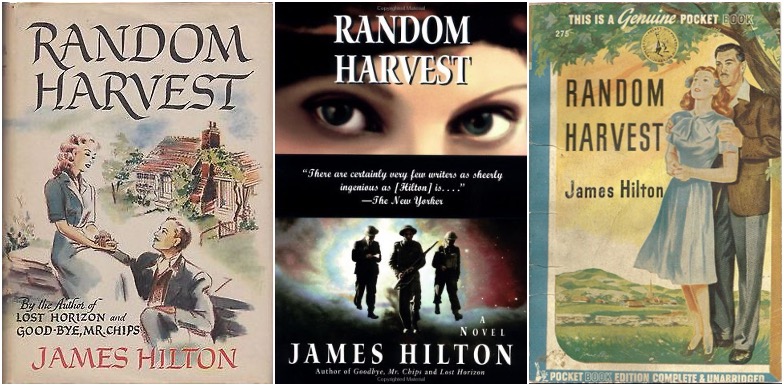
It’s only fair to start with Hilton’s original, after all, as it will also provide the springboard to talk about the picturization and its necessary modifications. The book begins at eleven o’clock on November 11, 1937, the nine-year anniversary of the signing of the ceasefire between Germany and the Allied powers and when our narrator, Harrison (we’re never given his Christian name), first encounters the mercurial industrialist and politician, Charles Rainier. Unexpectedly, the two form a unique bond, with Harrison fascinated by the puzzle that is Rainier and Rainier finding an impersonal confidant in the younger man. You see, Rainier is haunted by the mystery of his past: he remembers crouching in a foxhole in France, then waking up on a park bench in Liverpool two years later. Although he returned to his family home and picked up his pre-war life as best he could, the faint stirring of memory, of feeling, like a string tugging at the back of his mind, won’t let him dispel the sense that he’s lost something precious in those missing years. As Rainier slowly reveals his life story to Harrison, the feeling of dissatisfaction grows with each new dead end in his mind… until the pieces finally fall into place, forcing Rainier to choose between the two lives he has lived.
Taking place in 1918, just after the end of the Great War, and in 1937, on the eve of another, Random Harvest offers a fascinating glimpse into the social climate and feeling of the times, as well as a reflection on the repetitions of the past. Complacency is deplored, as England loses its postwar fervor and sinks back into its comfortable ways, allowing new enemies to grow until the threat can no longer be ignored. “These are the last days,” Rainier says after the signing of the Munich Pact. “…. And we are doing nothing – caught in the net of self-delusion and self-congratulation. We don’t realize the skill and magnitude of the conspiracy – the attempt to reverse, by lightning strokes, the whole civilized verdict of two thousand years.” Yet, writing in 1941, in the very midst of World War II, Hilton sees hope that the world will wake up, that “it may not be too late.”
“But a time may came when we, the dangerous men, shall either be killed or made kings – because a time may also come when it won’t be enough to love England as a tired businessman loves a nap after lunch. We may be called upon to love her as the Irish love Ireland – darkly, bitterly, and with a hatred for some who have loved her less and themselves more.” –Blampied, from Random Harvest by James Hilton
So, there is your introduction to the book – now on to the film! I admit, I may be biased because I fell in love with the movie long before I read the novel – but what a delight it was to discover Hilton’s work and find that I could still love both! [this is not always the case – the adaptation of Miss Pettigrew Lives for a Day is far superior to the novel, just as the the thrilling Scaramouche rather spoiled my view of the simplified film.] Then, of course, there is my undying love for both Greer Garson and Ronald Colman, so even if they are a trifle old for the scenes set in the past, I don’t really care and will happily watch them pretend to be hopeful young things any day. Part of that is their individual talent and part is their combined, easy chemistry.
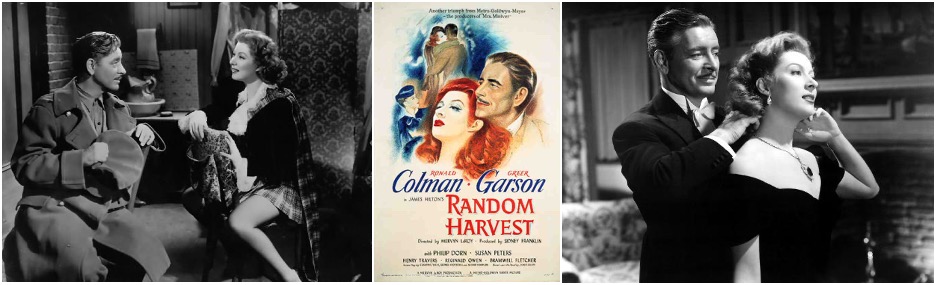
[Here’s where we get SPOILERY. If you’re averse, I’ll let you know when you can dip back in below, but you will miss the big comparison points of this review. Maybe read the book and/or watch the movie, then come back? Just an idea. I certainly don’t have an agenda to introduce everyone alive to Random Harvest. *ahem*] Now, the filmmakers were faced with one very clear problem in adapting this book: and that is the identity of Mrs. Rainier. In the novel, it’s revealed that during his “lost” years, Rainier was an amnesiac, who went by the name of Smith and fell in love with and married a bright young actress named Paula… who is, in the end, revealed to also be the current Mrs. Rainier, with whom he shares a marriage of convenience. And who, unbeknownst to him, found her lost husband and stood by his side for years, hoping he will remember and love her as he once did. (Are you beginning to sense the melodramatic angst that I love so much?) As you can see, following the original format of the book, where we learn about those lost years only at the end, would spoil the reveal of Mrs. Rainier entirely because you can see Greer Garson is both women. In a book, where imagination fills in the faces of characters, this isn’t a problem. In film, it is. So the screenwriters cut out Harrison (except for one throwaway scene – RIP, Harry, old sport) and shift the perspective from Rainier, who is missing key puzzle pieces, to Paula, who knows where the pieces fit but is afraid of the consequences if she forces the issue and doesn’t allow him solve it on his own.
Here, we can see that the film is less concerned with national or political commentary than with psychology (it is 1942, after all, and psychoanalysis was all the rage): by removing the mystery of what happened to Rainier, the emotional toil of not knowing is emphasized, as is Paula’s conflict over how to support him. Will telling him cause him to push her away, as an unwanted intruder in his current life? Or will the truth cause too much mental distress on a mind that has already survived so much? And so, changing the audience surrogate from Harrison to Paula not only solves the “Mrs. Rainer problem” but also allows us to view Rainier’s journey from another angle, creating a poignant mirror image that reveals her inner turmoil, as well as his, and the devastation of the loss from both perspectives. But again, Hilton is hopeful, and in another reflection of the larger political shifts, perhaps there is still time for Smithy and Paula, as well as for the world.

[Okay, END OF SPOILERS. You can come back now! I hope you used that time to stretch or get a snack or something.] Although critiqued by reviewers for it’s high melodrama and sentimentality, audiences loved the film, just as they did the book. And honestly, you still can see why it was a hit – MGM went all out with the production, bringing in top stars Garson and Colman and some of their best behind-the-scenes names, like art director Cedric Gibbons, cinematographer Joseph Ruttenberg, and, of course, director Mervyn LeRoy, among others. This investment certainly paid of, netting the film multiple Oscar nominations in addition to box office success. It was obviously filmed on a sound stage, with painted backdrops, but unlike some films of the era, it’s aged incredibly well. For one thing, it’s beautifully lit and shot, and the artful design and direction lend to the dreamlike quality of the story, particularly in the scenes where Rainier himself is slightly foggy or deliriously happy.
So, the adaptation not only does justice to the characters and story, but also to the atmosphere of the novel. Even Hilton seemed satisfied with the product and lent his voice for the opening narration. Sometimes, I feel protective of authors when I see adaptations of their work, but with Random Harvest I can happily enjoy knowing that he liked it, too, so I’m not betraying anyone. 😂
If this review has interested you even a little bit, I hope you’ll give Random Harvest a chance. I highly recommend both the book and the movie, and, honestly, I think you could enjoy it just as much starting with either. Starting with the book is probably the best way to get the full impact from the twist (see or don’t see the spoiler section above!). As someone who watched the adaptation first (and thoroughly enjoyed discovering the story that way), I’m always interested in hearing from folks who came to the story through the book first. So, if you check it out, be sure to let me know what you thought!
Happy reading (and viewing)!
–b
P.S. Here’s some bonus fun! Carol Burnett parodied Random Harvest for a skit on her show called “Rancid Harvest.” Maybe it won’t hit as hard if you don’t know the source material, but I found it hilarious. Watch it here!

 Book It With Becca
Nice review of the book and film. Colman’s silent pantomime at the end, demonstrating his mastery of silent screen acting, provides that unforgettable chill up the spine, not only for Charles longed-for resurrection in Smithy, but within the souls of the audience who are transmuted from mere passive observers into active participants in their reunion… One slight correction, the opening narrator is not James Hilton (despite that claim being widely circulated. The voice, sadly, remains unidentified and an enduring mystery…)
LikeLike