
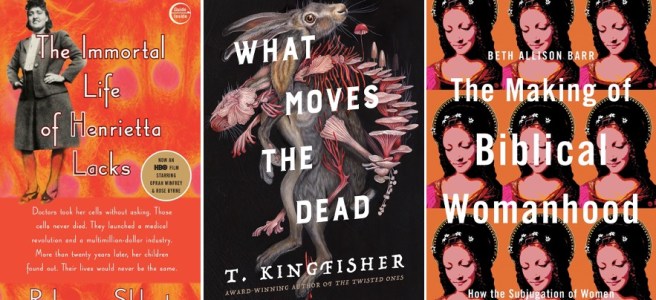
Trying to sum up this week’s reading or identify a theme is tricky. There’s everything from medical ethics to gothic romance, with theology in between. I suppose the common thread is a struggle to understand the past and move forward. The history books are looking at cultural injustices, seeking to right wrongs by sharing forgotten truths and making readers think critically about where we come from. And the fiction books, which are a mix of Gothic horror and Gothic romance, are concerned with healing, as characters work to overcome their traumas and find redemption. In a week when I didn’t think I was up to much deep thinking, these choices made me do just that, and I think it was exactly what I needed.
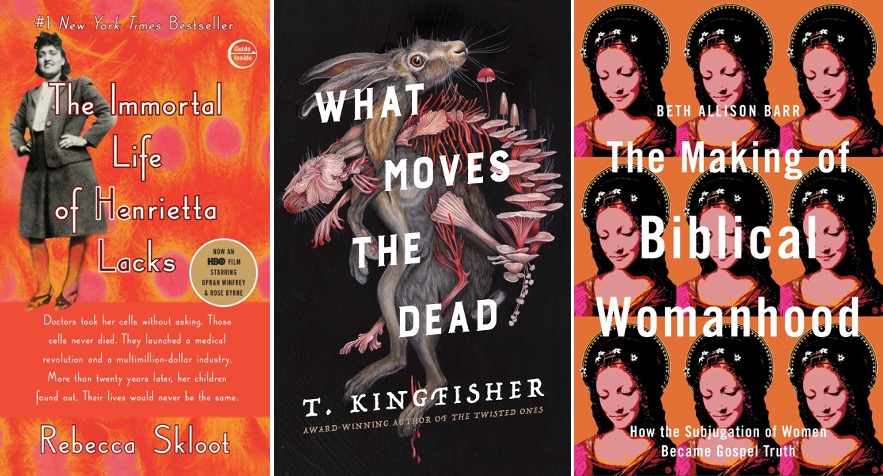
The Immortal Life of Henrietta Lacks by Rebecca Skloot: A fascinating, and at times devastating, look at the life and scientific afterlife of Henrietta Lacks. Skloot strikes a fine balance between admiration for what HeLa cells have made possible and censure of the medical community’s treatment of Henrietta and her family. This is the story of Henrietta, of groundbreaking discovery, and of medical injustice — and it’s also the story of a woman desperate to know what happened to her mother. I can’t recommend this highly enough to anyone interested in medical history, African American history, and the often painful intersection between the two.
What Moves the Dead by T. Kingfisher: Horror isn’t my usual genre of choice, but T. Kingfisher is an automatic read at this point, and add in that What Moves the Dead is old-school gothic horror? Based on Poe’s “The Fall of the House of Usher”? Well. How could I resist? The story begins with charm, humor and a pall of dread that only grows as we learn more about what’s happening. I think what kept me from going mad myself was the solidly grounded narration of Alex Easton, a former soldier with an extremely practical mind, not prone to fretfulness or fancy. Of course, the fact that even Easton occasionally freaks out is also what makes the fantastic events so chilling. Brilliantly done, delightfully told (only T. Kingfisher could make a horror tale delightful!), and best read in broad daylight. My thanks to NetGalley and Macmillan-Tor/Forge, Tor Nightfire for providing an eARC in exchange for an honest review.
The Making of Biblical Womanhood: How the Subjugation of Women Became Gospel Truth by Beth Allison Barr: Barr, a medieval historian specializing in church history, eloquently argues against the ideas of “Biblical womanhood” and complimentarianism that are so prevalent in modern Christianity. She contextualizes verses commonly misinterpreted to uphold patriarchy, examines the roles of women in the early church and how they changed over time, and shows how Biblical womanhood is not only in opposition to Biblical teachings but also a relatively modern concept. For any woman who grew up in an Evangelical church, Barr’s text is a balm to the soul, an affirmation of the way we have been limited and wounded merely because we are not male. Even if you’re not of this background or even of the Christian faith, I strongly recommend this as a source for learning more about why the modern church looks the way it does and what it could look like if it embraced the true tenets of Christianity and granted equality to all God’s followers. Reading this was both a comfort and an affirmation of my experience, and I know I’ll be coming back to it again and again and using it as a starting point for further reading. Also — who else is obsessed with that cover??
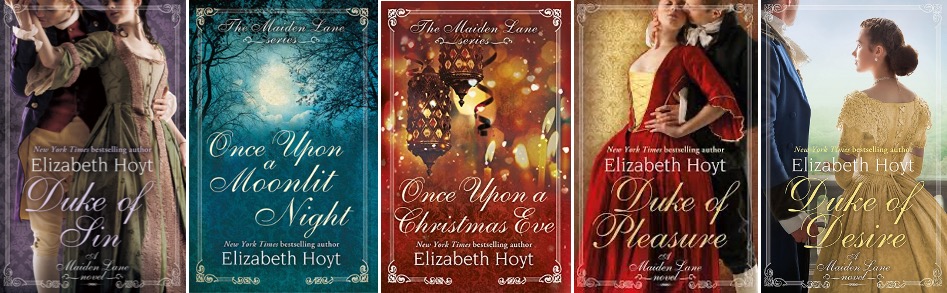
Maiden Lane #10-12 by Elizabeth Hoyt: Aaaaand done! Until I go back and read the first few in the series that that I missed because I started midway, that is. This last arc was fun but definitely leans into some of the more nasty tropes of gothic romance. And I do mean old-school Gothic Romance — if you’ve read The Monk by Matthew Lewis or similar books, you’ll have an idea of some of the more disturbing plot points. While I enjoyed all of the leads (the Duke of Montgomery is a delightfully sinister antihero), I preferred the two novellas in this stretch most because, well, they were happier, even with their dramatic elements. Overall, I’m still very much enjoying these, and I look forward to reading the earlier books in the series.
So, those are my recent reads — and there’s certainly plenty there to latch onto. What are some of your favorite books that made you think or helped you articulate an experience you couldn’t before?
—b

 Book It With Becca
Wow, it looks like you had an incredible week of reading! I loved that you managed to find a theme that links all these books together. I do have the Immortal Life of Henrietta Lacks on my TBR and I”m definitely looking forward to checking it out. I’m also very curious about T. Kingfisher’s stories, although horror is very much not my jam 😅, I keep hearing wonderful things about all their books and it makes me want to try one ASAP! I hope you have a wonderful week of reading ahead 🙂
LikeLiked by 1 person
Kingfisher’s become such a favorite over the past 6 months or so! But yeah, she definitely enjoys the creepy and unsettling. 😅 I think Paladin’s Grace (and the Saint of Steel series as a whole) would be a great place to start, though, because it’s balanced with a lot of humor. Swordheart is even more on the romance end of the spectrum, but it’s very light on plot.
LikeLike