
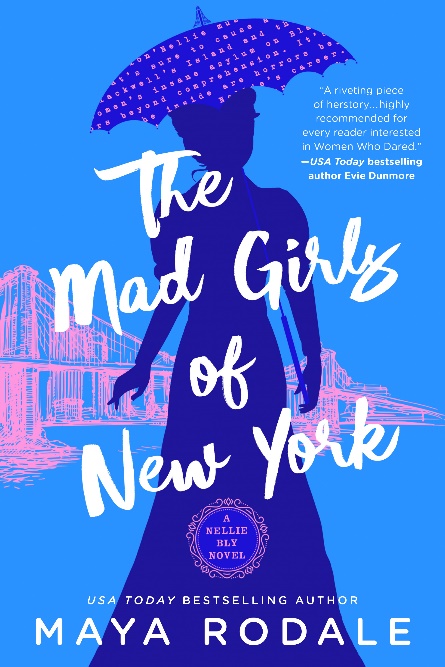
Sometimes a book comes along that has all the right ingredients, but the measurements are slightly off. You want to love it, but it’s not quite right for you. That’s how I feel about Maya Rodale’s The Mad Girls of New York, the first in a new series following the exploits of real-life trailblazer Nellie Bly. All the components of a great story are here (Bly’s real life certainly is that great story), but issues with tone make it a more confusing than inspiring read.
It’s 1887, and Nellie Bly is newly arrived in New York and ready to make her mark in journalism. The only problem is, she can’t get anyone to take her seriously — until in desperation, she pitches to feign madness and get committed to the infamous asylum on Blackwell’s Island. There are whispers of women disappearing off the streets only to be sent to the island for supposed insanity, and the few tales of what actually goes on there are horrifying. If Nellie can survive long enough to get out and write her exposé, her career will be made. But conditions are worse than even she imagined —and while she’s locked up, a rival reporter is trying to scoop her story!
While reading, I thought a lot about old movies, particularly the ones concerned with the newspaper business. In the sections outside Blackwell’s, Rodale seems to be trying to emulate the tone of films like His Girl Friday (1940) and Roxie Hart (1942) — sharp, fast-paced, darkly funny with a core of truth about the news rat race and society. It’s a difficult balance to execute on paper, and I think Rodale fails primarily because she’s too earnest. Her message isn’t about the ethical pitfalls of reporting the news or the public’s obsession with scandal. It’s about the desperate plight of women in a patriarchal society, with our intrepid girl reporter bent on truth and justice!
And that earnestness pushes the tone from gallows humor and those great ’40s films to farce and Natalie Wood’s Maggie DuBoise in The Great Race (1965). (Maggie, of course, as many have noticed, is an obvious take on Bly, with her impassioned speeches and news stunts.) And while Maggie worked in a film sending up every character type, in a book that’s uncommitted to either a dramatic or comedic extreme, Nellie presents more as a mouthpiece for the author’s agenda than as a fully realized character. To me, it all came off as Feminist™️ rhetoric that’s a bit too self-righteous and preachy, a tad internally misogynistic in places (Lord save ME from women who belittle other women whose dreams/behaviors are more traditionally “feminine” — the whole point of feminism is that we all deserve to choose), and far too obvious with its 21st century talking points. Which is not to say there weren’t people back then fighting for social justice — Nellie Bly really existed, after all, and wrote extensively about the lives of women in a man’s world. But with more than a hundred years of social change and scholarly debate between them, 19th and 21st century people are simply not going to talk about these issues in the exact same way, and the jarring anachronism was a distraction.
However, I know I think too much about contemporary vs. historical fiction writing and the way it affects storytelling, so maybe the above issues won’t bother others as much as they did me. The nice thing is that, tone aside, it is a good story and talks about very real issues. If you want to read more about the history of women in medical systems and in the workforce, this isn’t a bad starting place. Rodale’s author’s note is certainly filled with events and people you want to run off and read about right away.
My thanks to NetGalley and Berkley Publishing Group for providing an eARC in exchange for an honest review.
—b

 Book It With Becca
One thought on “The Mad Girls of New York by Maya Rodale”