
A couple of weeks ago, I discovered and devoured Grace Burrowes’s “Rags to Riches” series, featuring the prickly, stubborn Wentworth family, who rose from the gutters of York to affluence in London… and then learned they were the descendants of an ancient ducal line. Burrowes doesn’t reinvent the wheel with this series, by any means, but she does do a few interesting things that made it a standout for me. And since I have so much to say, I’ve decided to do a full series review, rather than try to cram it all into a Reading Roundup post! Let’s dive in, shall we?
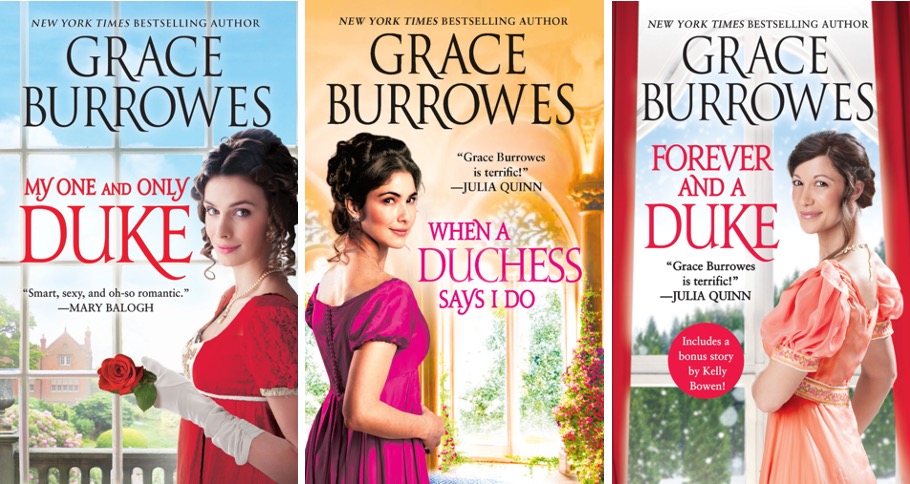
Book one, My One and Only Duke, begins in Newgate Prison, where banker Quinn Wentworth awaits hanging for a murder he didn’t commit. With execution imminent, Quinn marries Jane, the pregnant daughter of a poor clergyman ministering to the prisoners, giving her and the child the protection of his fortune and his tarnished name. When the College of Arms intervenes at the very last minute to stop Quinn’s hanging and declare him the long-lost heir of a dukedom, Quinn and Jane find their brief marriage of convenience won’t be so brief or so convenient. The couple – and the entire Wentworth family – will never be the same.
Something that caught my attention – aside from the immediate yet believable connection between the leads – was the use of multiple points of view. As readers will know, most romance novels alternate POV between the two romantic leads, and if it’s a series, the POV will switch to the next lead couple in the next book and so forth, even when the previous couples are still part of the story. In “Rogues to Riches,” Burrowes mainly focuses on the leads, of course, but also gives every major character (and a few minor ones, too) a chance to lend us their perspective, which not only creates a richer understanding of the world of the book but also gives the audience an outside view of the main couple, as individuals and as a pair.
Another benefit of giving more than just the leads’ viewpoints is that, as the series progresses, we still get the thoughts of previous leads and insight into their continued growth after their book ends. An excellent example of this is the relationship between Quinn, the eldest Wentworth sibling, and Stephen, the youngest. In book one, we mainly hear Quinn’s perspective as the oldest child who threw himself into work to feed his younger siblings – and later, to give them educations and material comforts. We know his relationship with the teenaged Stephen is complicated, that the two brothers don’t really understand each other, but we’re generally on Quinn’s side because he’s the hero, and we know best what he went through. And we know it was awful.
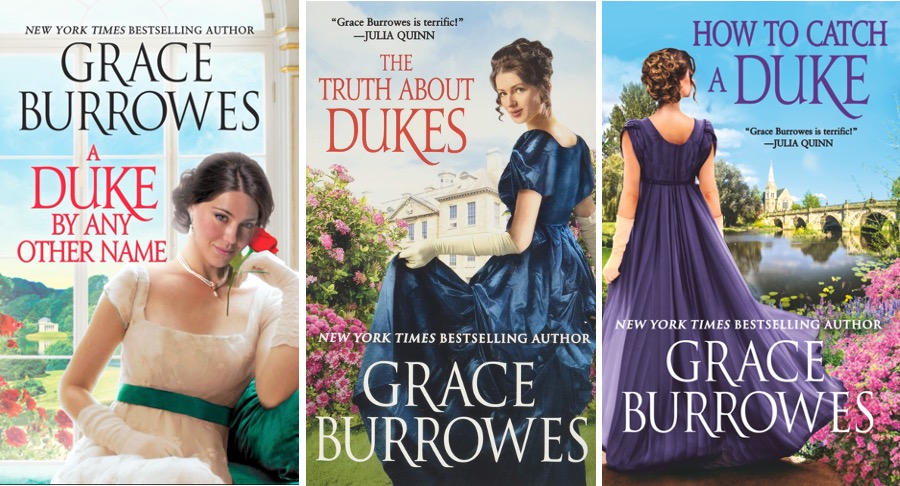
But as the series progresses, we gain more and more insight into what it was like for Quinn’s sisters and brother, and by Stephen’s book (#6, How to Catch a Duke), we fully understand just how shitty is was to be left with an abusive father, even if your older brother only left to put food on the table. And when Stephen and Quinn are finally able to talk about that, not only do we have several books of reading about Quinn’s, the sisters’, and Stephen’s histories and lingering traumas but we also have, in the present, both of their perspectives. So we see just how much those memories and that conversation affects both of them. It’s not just Stephen coming to terms with his experience and his feelings. It’s that and Quinn going upstairs to cry in Jane’s arms for what his brother went through and for what he wasn’t able to do for him, which the Quinn of book one (even at the end) couldn’t have processed in a healthy way. And we, as readers, are able to love and have compassion for them both, to see that they both did the best they could and truly care for each other, even when they don’t understand each other. In a series where you only get the POV of the romantic leads, you lose the opportunity for moments like that, especially over the course of a series.
The second thing Burrowes does really well is portray complicated, ever-evolving characters who are living with trauma, mental illness, and physical disabilities. As I mentioned, the Wentworth sibling grew up in abject poverty with an abusive drunkard for a father, and even in their present affluence, they still live with the effects of those early years. So, too, do many of their partners come with their own dark histories and present impediments. Quinn blames himself for everything he was too young and powerless to change. Althea carries the humiliation and trauma of a child begging on the streets. Constance drowns the hurt of giving up her illegitimate child when she was but a child herself. Stephen lives with the pain and limitation of the leg his father broke when he was a boy, putting up a bold front to combat pity or mocking. Robert (Constance’s love interest) fights to overcome the horrors of the mental asylum where he was raised after a childhood accident left him with epilepsy. These are the ones I mention, but every character comes with his or her own struggles and personal hang-ups.
While some writers might use these things for mere background or, heaven forbid, to add an “edge” to the story (*rolls eyes* – never, ever do something just to be edgy, folks), Burrowes interacts with them thoughtfully and intimately, and there are no magical solutions. They each learn to manage their limitations, whether physical or mental, but not without putting in the work. There are no doctors here to provide miracle cures, and finding love doesn’t erase where the characters come from or the difficulties they still face.
What love does do, however, is give them a partner to lean on and fight beside when things are bad and a friend with whom to share the good things in life. And, because this is the chaotic, fierce Wentworth family, it also gives them a small army of men and women to back them up and look out for their best interests, whether they want it or not!
From the first, I loved this series. And although I usually don’t fall in love with characters, I found myself doing just that with many of the Wentworth family and their friends. In lesser hands, this could have been shallow melodrama, but Burrowes’s writing is sharp and smart. She even surprised me a few times – laying groundwork I thought would lead in one direction, then revealing she was doing something else all along. She’s created a rich world, full of diverse and interesting characters who all have their own journeys and worldviews, and seeing them all continue to grow as individuals and as a group is truly satisfying. I can’t wait to see where future books take them!
–b

 Book It With Becca
This a great review of the series! I love the way that you write!
LikeLiked by 1 person
Awww, thank you! ☺️
LikeLiked by 1 person
I really enjoyed the first book
LikeLiked by 1 person
That one was definitely my favorite! I’m not sure I’d reread the others, but I can easily see myself going back to the first.
LikeLiked by 1 person